

Guide
Oct 16, 2026
Key takeaways
For one program office or department, upload an Excel list on the Certi platform and issue right away. Korea University, Gachon, Kwangwoon and Jaeneung work this way
For a whole school, connect the student and co-curricular systems by API, and students who meet the requirements get badges automatically. Hoseo University works this way
Either way, badges build up in each student’s account, and the school uses the issuance history as outcome data
Why use digital badges for co-curricular programs?
Co-curricular programs happen outside class, so the results never reach the transcript. Schools record them with certificates or mileage points, but those records are hard to check from outside the school.
A digital badge is an online credential that holds the program name, criteria, issuer and date. Anyone can check it with one link, so students can show it on their résumé and LinkedIn as is.
| Certificates and mileage | Digital badges | |
|---|---|---|
| Checking from outside | A copy has to be submitted separately | Checked instantly with a link |
| What it holds | Program name and date | Criteria, skills and issuer too |
| Where it's kept | Inside the school's system | In the student's account, even after graduation |
From one program office to the whole school: two ways
Universities use digital badges in two main ways. Pick by size and by where your school’s systems stand. You can also start small and grow later.
Issue straight from the Certi platform
Start with one program office, department or center. Create a badge, upload an Excel list, and send it all at once by KakaoTalk and email. No development needed.
Connect your student system by API
Link the whole school's student and co-curricular systems. When a student meets the requirements, the badge is issued automatically.
Option 1. Issue straight from the Certi platform
Sign in to the Certi platform, create a badge, upload the list of students as an Excel file and click Issue. Students get the badge by KakaoTalk (Korea’s most-used messaging app) and email, and open it with the link in the message.
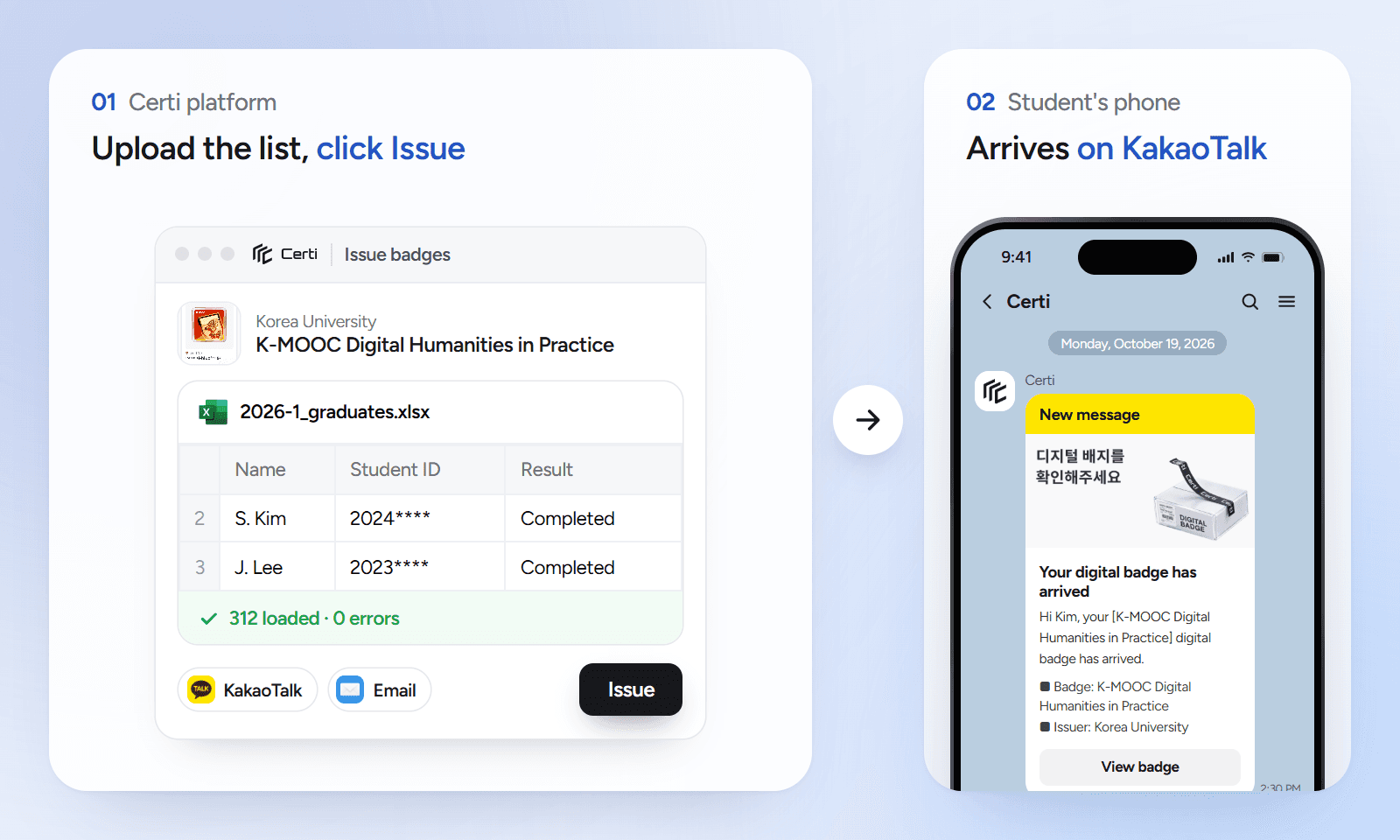

One program office, department or center can start right away. There’s no waiting on the school’s IT team, and you buy a pass for only as long as you need it.
At universities, Korea University’s K-MOOC, Gachon University’s Semiconductor Specialized University Support Program, Kwangwoon University’s Online Education Support Center, Jaeneung University have issued badges this way.
Option 2. Connect the whole school’s student system
As programs and students multiply, it gets hard for staff to tidy and upload a list for every session. Connect the school’s co-curricular system to Certi by API, and a student only has to press Get badge on a completed program: the badge is issued and added to the student’s My badges automatically.


Hoseo University uses Certi connected to its campus-wide student system and co-curricular programs. Its self-development certification badges are split by area, such as career challenge, career planning, learning growth and personal growth, and each area has Level 1, 2 and 3. For example, the Career Challenge Badge (Level 1) goes to students who complete the online job bootcamp.
The scope of integration depends on the school’s systems and is set together during onboarding. The Pro plan includes support for integration development.
Which option fits your school?
| Option 1 Certi platform | Option 2 API integration | |
|---|---|---|
| Best for | One program office, department or center | Campus-wide co-curricular and curricular programs |
| How badges are issued | Upload an Excel list and issue | Issued automatically when requirements are met |
| Development | None needed | Integration with the school's system |
| Getting started | The day you sign up | After the integration scope is set |
You don’t need to integrate from day one. Start with one program office on the Certi platform, and expand to a campus-wide integration as programs grow.
How much does it cost for 100 to 1,000 students?
One credit issues one badge, and recipients pay nothing. Each plan adds credits every month, and annual billing (12 months) saves 15%. Pick the plan that fits how many badges you issue in a year.
| Badges a year | Plan | Cost with annual billing (VAT incl.) |
|---|---|---|
| About 600 | Mini · 50 credits a month | KRW 6,600 a month · KRW 79,200 a year |
| About 1,800 | Basic · 150 credits a month | KRW 18,700 a month · KRW 224,400 a year |
| About 6,000 | Pro · 500 credits a month · API integration support | KRW 49,500 a month · KRW 594,000 a year |
For 1 to 11 months, it’s KRW 7,700 (Mini), KRW 22,000 (Basic), or KRW 58,300 (Pro) a month. In a month when you issue a lot at once, buy extra credits at KRW 300 each. The free trial gives you 30 credits for one month, with no card required.
See the pricing page for plans, and the pricing and payment FAQ for credits and how to pay.
What should you decide before you start?
Whichever option you choose, decide these four things first, and badges keep the same standard even when staff change.
| Decide | Example | Why decide it first |
|---|---|---|
| Areas | Career, career planning, learning skills | Badge names and designs can match as a set for each area |
| Levels | Level 1, 2, 3 or participation, completion, honors | Students get a reason to aim for the next level |
| Criteria | One line, such as completing a job bootcamp | Anyone who sees the badge knows what was achieved |
| Skills | Career skills, the school's core competencies | Each badge shows which skills were built |
For more on splitting badges into levels, see How to issue digital badges in tiers. Pick skills from the list in Certi and AI suggests the ones that fit.
How does each student’s record build up?
Badges collect in My badges in the student’s Certi account. Badges from different programs and other institutions sit in one place, stay in the account after graduation, and can be shared with a link at any time.
School staff can open a student’s profile on the platform to see all the badges that student has received.
For how students add badges to a résumé, see How to add a digital badge to LinkedIn and your résumé.
How do several departments and program offices share it?
There’s no limit on admin accounts, so the student affairs office, departments and program offices can all work under one school name. Each office gets its own permissions, and every badge issued gathers on the school’s organization page.
Support for splitting one school into several organizations (teams) is coming soon.
How do you use it as outcome data?
Each badge keeps a record of who received it and on what criteria, and the Certi platform shows issuance and view status for each badge. Download the issuance history as an Excel file to use in outcome reports.
For documenting outcomes for programs such as ANCHOR, see How to document ANCHOR program outcomes with digital badges. Check your program guidelines first to confirm badges fit the performance indicators.
What does Certi offer?
The same Certi works from one small program office to the whole school. Korea University, Gachon, Kwangwoon and Jaeneung issue from the Certi platform, and Hoseo University issues through its student system integration. Here is how Certi answers the questions schools often ask when choosing a service.
| Check | Certi |
|---|---|
| International standard | 1EdTech certified for Open Badges 2.0 and 3.0, and anyone can verify a badge with its link |
| How pricing works | Prices are public, and one credit issues one badge. Recipients pay nothing |
| Korean support | The admin screens are in Korean, and support is available in Korean right away |
| How students receive it | No app to install. Students open it straight from the KakaoTalk or email link |
| Bulk issuing and integration | Issue all at once from an Excel list, and connect the student and co-curricular systems by API |
| After your term ends | Badges already sent stay, and you can download the issuance history as an Excel file |
| Personal data | Data is encrypted and stored on servers in Korea (Naver Cloud) |
| Purchasing | Card payment, tax invoices, purchase through S2B (Korea’s school procurement marketplace), and quotes |
| Certificates | Give a PDF certificate in the school’s own format with the same information as the badge |
Frequently asked questions
Q
Do we have to integrate with our student system?
No. You can upload an Excel list on the Certi platform and issue right away. Start with one program office, and connect the student and co-curricular systems by API when you expand to the whole school.
Q
Which universities issue badges with Certi?
Korea University's K-MOOC, Gachon University's Semiconductor Specialized University Support Program, Kwangwoon University's Online Education Support Center and Jaeneung University issue from the Certi platform at the program-office level. Hoseo University connects its campus-wide student and co-curricular systems to issue its self-development certification badges.
Q
Can we use badges if we already have a co-curricular mileage system?
Yes. Keep mileage as points used inside the school, and use badges alongside it as credentials anyone outside the school can check.
Q
How much does it cost for a university with 100 to 1,000 students?
Pick a plan by how many badges you issue a year. With annual billing, it’s Mini KRW 6,600 a month (50 credits a month), Basic KRW 18,700 (150), or Pro KRW 49,500 (500), all including VAT. Recipients pay nothing, and you can try it first with a one-month free trial (30 credits). If you issue more than 3,000, you can buy credits at bulk rates (KRW 200 each, or KRW 100 each from 10,000, VAT excluded).
Design your school's co-curricular badges with Certi
Contact sales
Keep reading
All posts


