Guide
Oct 8, 2026
Key takeaways
Open Badges is the global standard for a digital badge’s contents and verification
In 3.0, every badge carries the issuer’s digital signature, so it can be verified outside the issuing platform and kept in a wallet
When choosing a platform, check for 2.0 and 3.0 certification, signatures, DIDs, wallet portability and API issuing
What is it, in one sentence?
Open Badges is the global standard for digital badges. It is maintained by 1EdTech, an international nonprofit that develops education technology standards.
Think about phone chargers. When every company uses a different plug, each phone needs its own charger. Once everyone switches to USB-C, one cable charges any phone.
Digital badges work the same way. If every platform invents its own format, a badge can’t be read, or checked for authenticity, anywhere else. Open Badges is the global standard that gives every badge the same format and the same way to verify it.
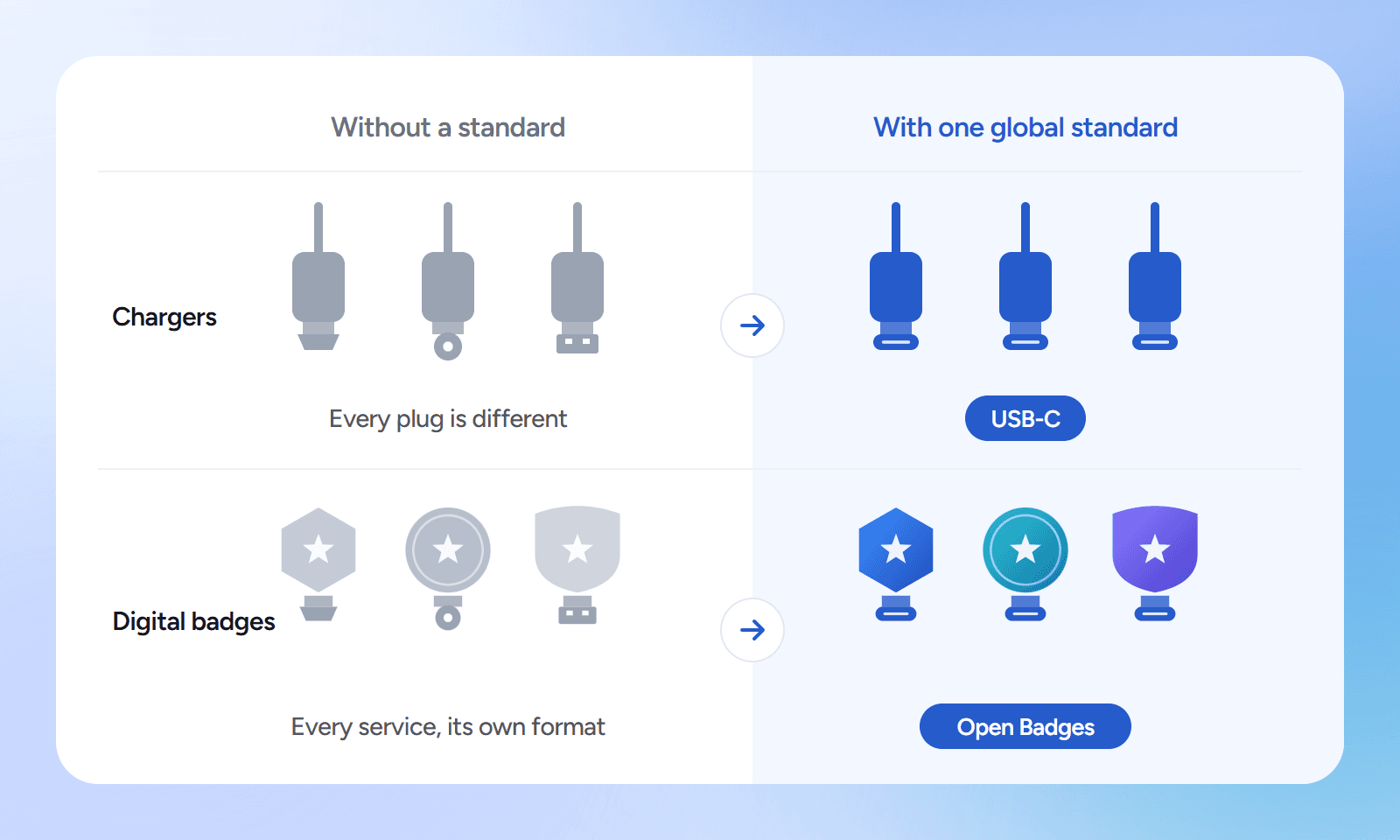

A digital badge is any online credential. An Open Badge is a digital badge that follows this global standard.
Who created it, and when?
Open Badges has been refined for more than ten years. The organization that started it is not the one that maintains it today, and the way badges are verified changed as the versions moved on.
- 2011
Mozilla starts it
Launched Open Badges as a digital badge standard anyone could use
- 2017
1EdTech takes over
The education technology standards body (then IMS Global) became its steward
- 2018
Open Badges 2.0
Defined badge data and verification; the most widely used version
- 2024
Open Badges 3.0
Aligned with the global format for online credentials, verified by signature
How does Open Badges 2.0 work?
Most 2.0 badges are stored on the platform that issued them. To verify one, you check it against the issuance record kept on that platform. Recipients are usually identified by email address.
Because it has been around for years, many of the badges issued so far are 2.0, and many badge collection services read 2.0 badges.
What changed in Open Badges 3.0?
A 3.0 badge uses the same format as Verifiable Credentials1, the global format for online credentials. The issuer digitally signs every badge, so the badge itself proves who issued it and what it says, without asking the issuing platform.
| Open Badges 2.0 | Open Badges 3.0 | |
|---|---|---|
| Format | Its own Open Badges format | Same format as Verifiable Credentials |
| Verification | Mostly checked against the issuing platform's record | Checked with the issuer's signature inside the badge |
| Recipient ID | Mostly email address | Email and other identifiers |
| Storage | Kept on the issuing platform or a badge collection service | Still verifiable after moving to a digital wallet |


For recipients, the biggest change is that a badge is no longer tied to one platform. It becomes a record they carry with them.
2.0 or 3.0: which should you use?
Both are in use today. Most badges already issued, and the services that read them, are 2.0, while new platforms and wallets are moving to 3.0.
So when choosing a platform, look for support for both. You can check certification by searching the platform’s name in 1EdTech’s official certified products list, which shows each version and certification date.
How do you choose an Open Badges 3.0 platform?
Supporting 3.0 can mean different things on different platforms. These five points show whether a badge will stay useful to its recipient for years.
The unfamiliar term here is probably DID2. It identifies the issuer by its own digital identity rather than by an account on one company’s service, so you can still confirm who issued a badge even if the issuing platform changes.
| What to check | Why it matters |
|---|---|
| 2.0 and 3.0 certification | Badges verify wherever they are read, whichever version |
| Issuer digital signature | The badge itself proves who issued it |
| DID | Issuer identity is checked without relying on one platform |
| Wallet portability | Recipients carry badges as their own records |
| API issuing | Learning platforms can send a badge the moment a course is completed |
Is it used in Korea?
Yes. Ministry of Education programs such as K-MOOC Digital+ (Korea’s national online course platform), the AID 30+ bootcamps for working adults and the Youth Leap talent bootcamp award digital badges to graduates, and these badges follow the global standard.
In 2024, the Ministry of Education and the Korea Education and Research Information Service (KERIS) convened a national digital badge council to discuss wider adoption. Before that, KERIS reviewed Open Badges 3.0 as the standard technology for digital badges in a 2023 research report.
How does Certi cover these?
Certi is certified for both Open Badges 2.0 and 3.0. Here is how it covers the five points above.
- 3.0 badges carry the issuer's digital signature and DID
- Issuance records are also written to a blockchain, so anyone can check a badge against its original record
- Recipients can move their badges into other digital wallets and badge collection services
- Learning platforms can issue badges automatically by sending completion data through the API
- Administrators can issue to a whole Excel roster at once and deliver by email or KakaoTalk (Korea's most used messenger)
It is used for university co-curricular programs, government initiatives and corporate training. See real badges in the Korea University K-MOOC, Ministry of Education Startup Teams 300+, SK hynix Heinstein stories. Administrators never have to touch the specification: enter the badge details in Certi and the badge is issued to the standard.
Frequently asked questions
Q
Once 3.0 is out, can 2.0 badges still be used?
Yes. Both versions are in use today, and badges already issued under 2.0 don't need to be reissued as 3.0.
Q
How can I check whether a platform is Open Badges certified?
Search for the platform's name in 1EdTech's official certified products list. It shows the certified versions and dates.
Q
Does Open Badges 3.0 require blockchain or DIDs?
The standard defines verification by digital signature and does not require blockchain. Certi adds a DID to its 3.0 badges and also writes issuance records to a blockchain so they can be checked.
Q
Do I need developers to issue Open Badges?
No. You can issue straight from an Excel roster. The API is only needed if you want your learning platform to issue badges automatically.
Need to issue Open Badges? Talk to Certi
Contact sales
Keep reading
All posts